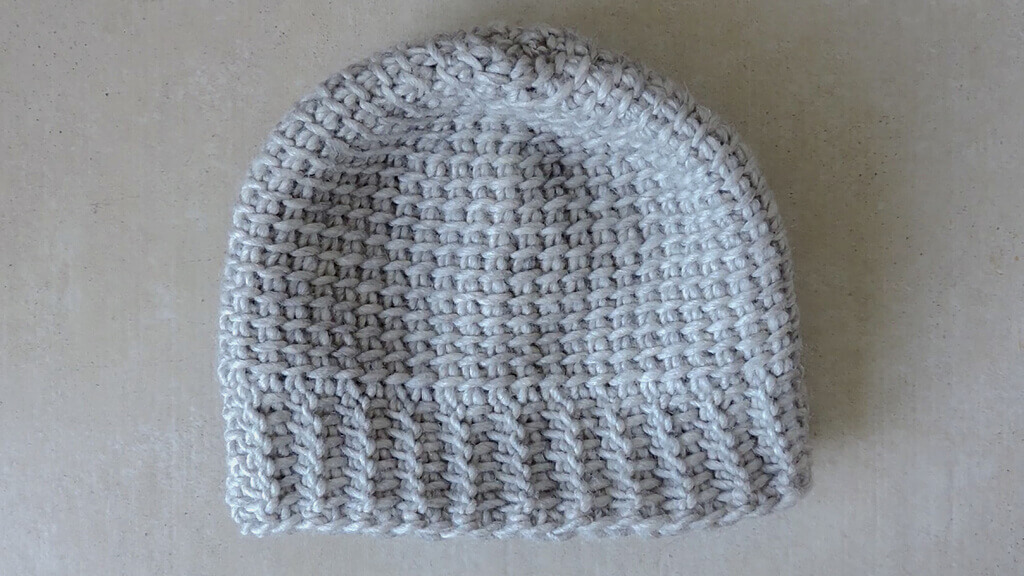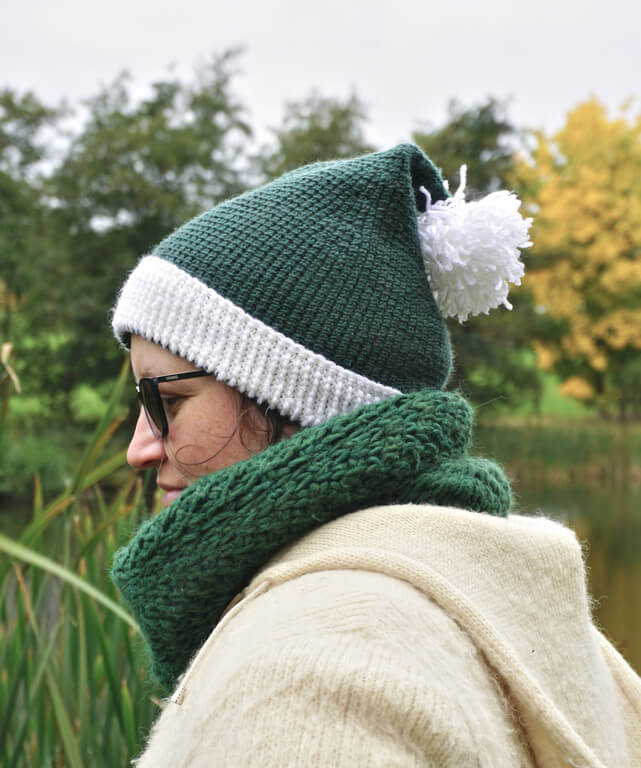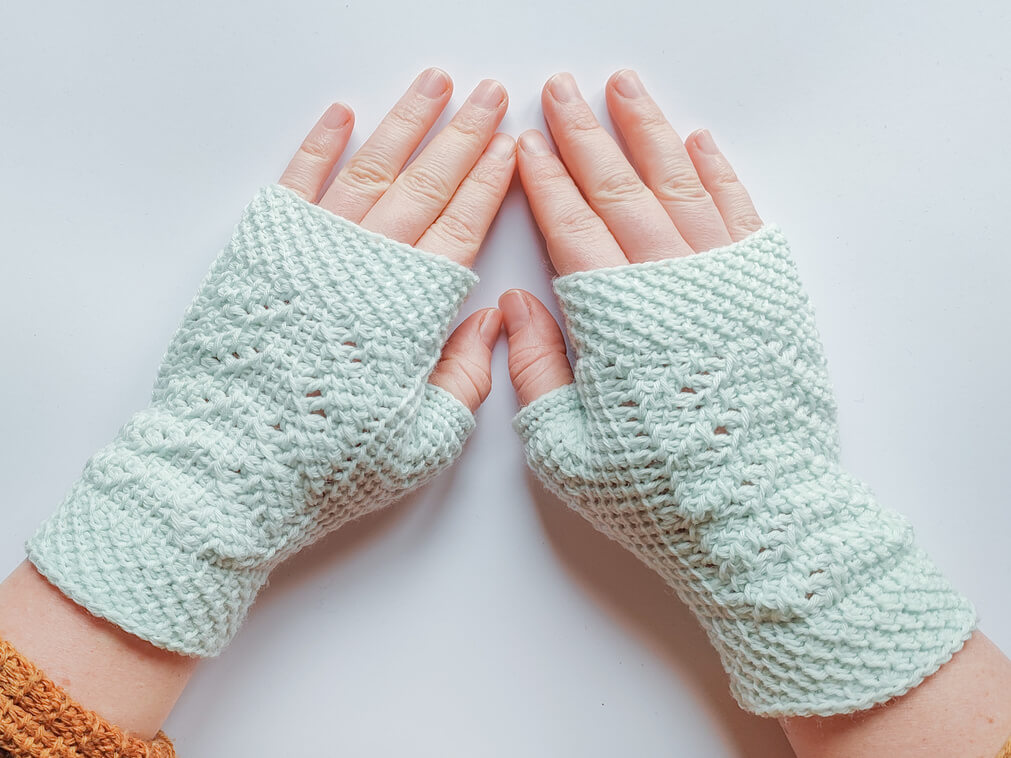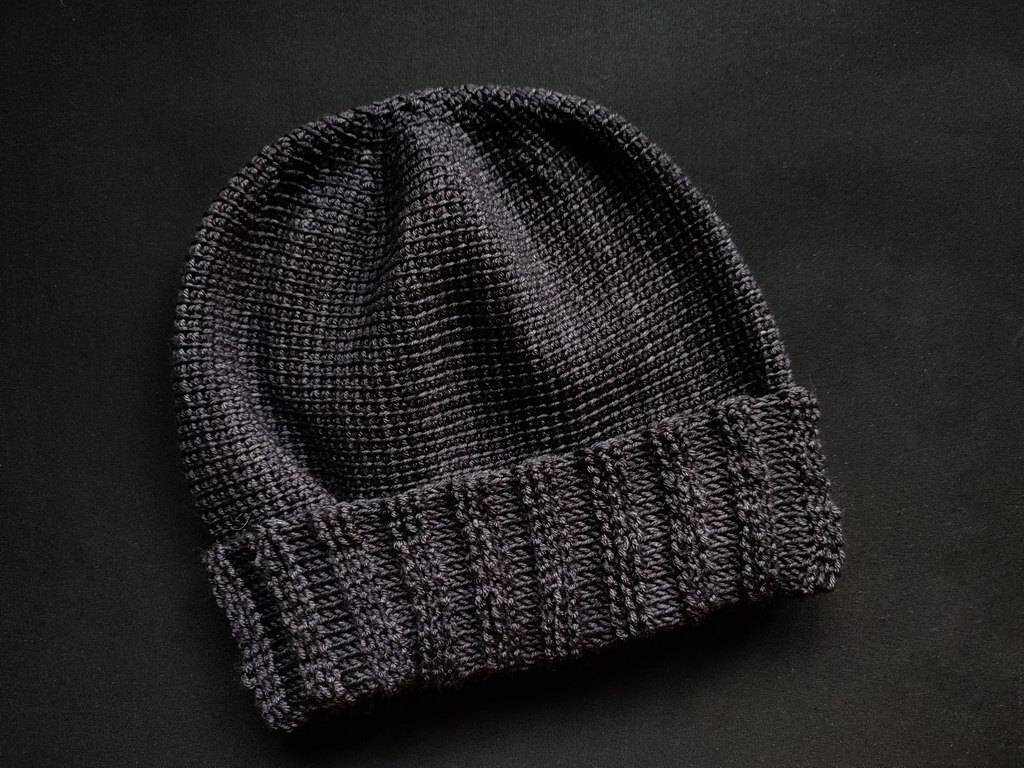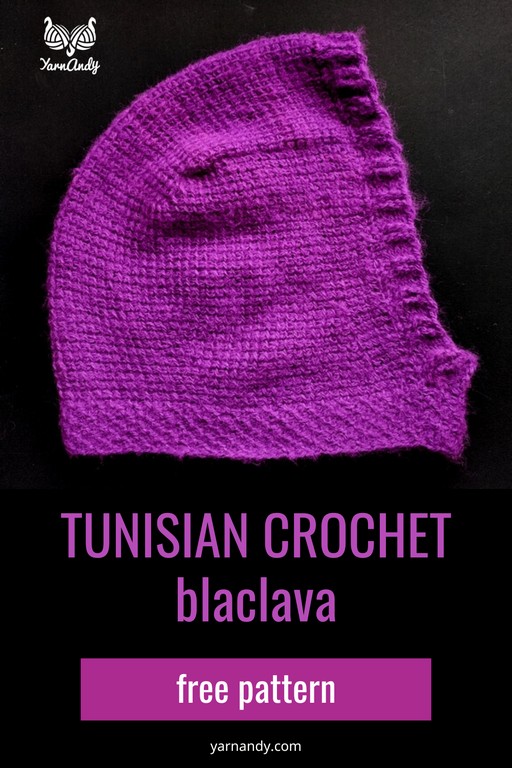
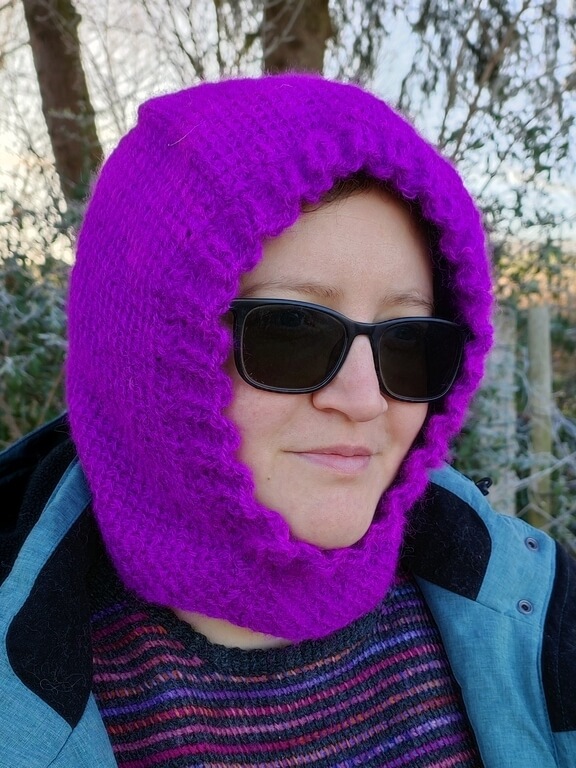
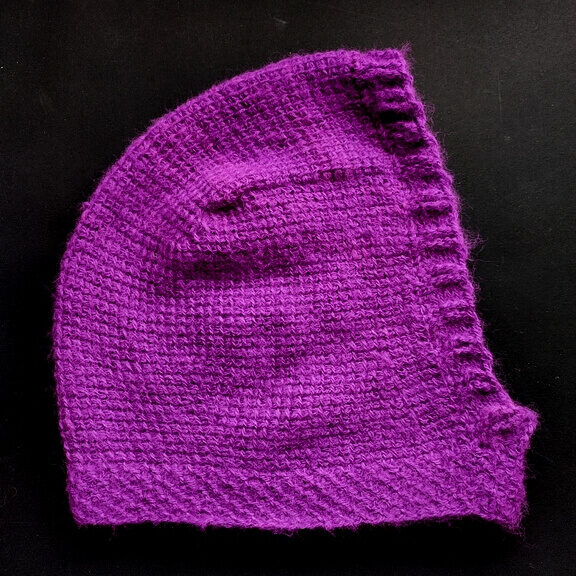
Blend in a crowd or stand out – the choice is yours, based on the color you choose to make your balaclava in. It is more of a hooded cowl than a ski mask, although I intend on designing one of those as well.
Use it for walking the dog in the freezing temperatures or when out protesting. Keep your face from freezing, especially if you’re like me and have sensitive cheeks.
You can push it further back for better visibility, of hide your face in it when the winds blow.
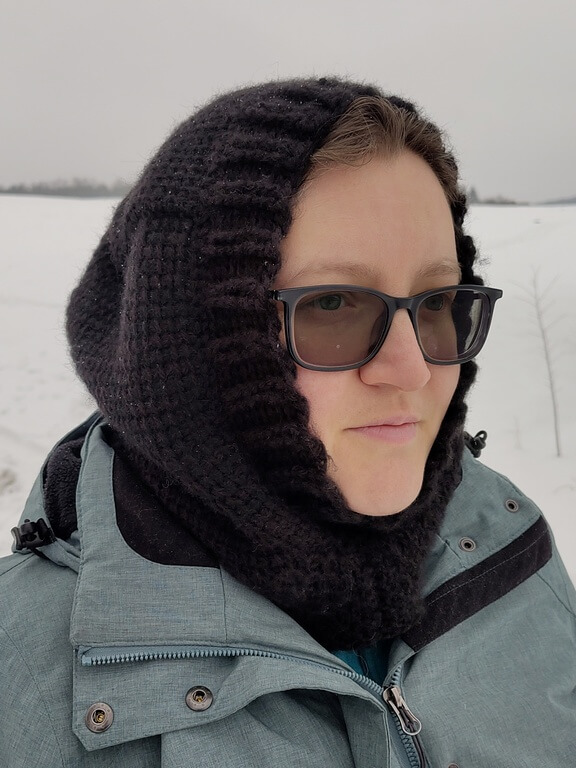
Make one in a bright, eye-searing yarn like my purple one to express your personality, or choose a muted, dark color if you intend to donate it.
This Tunisian crochet balaclava is easy to make and it’s roomy enough to wear over a snug fitting hat or headband, and it’s perfect for people with big heads or a lot of hair.
It’s not as showy as a red tasseled hat (Ravelry link), but it will keep you or others safe during this and future winters.
Contents
About the pattern
This balaclava is large and simple and will keep your head and cheeks warm while you are out and about in the freezing cold. Wear it over a snug beanie or ear warmers on a cold day, or just on its own on regular winter days.
The balaclava is worked from the top down, first as a rectangle. Then stitches are picked up around it and shaping is used to make the vertical part, then new stitches are cast on at the chin to make the neck area.
Ribbing is made all around the face opening and two small seams complete the project.
The ribbing can be made wider or narrower, depending on how much of the face you want to be exposed.
You can adjust the size by changing either the size of the hook or the thickness of the yarn. The final fit around the face can be adjusted by changing the width of the ribbing.
For a tighter fit, use yarn with high twist and multiple strands. For a looser fit, use a yarn with lower twist, fewer plies, a brushed or chainette yarn.
Measurements
The balaclava measures 66 cm or 26” horizontally (width), 37 cm or 14.5” vertically (height).
The width can be adjusted when making the ribbing. The height can be adjusted while making the side or the bottom.
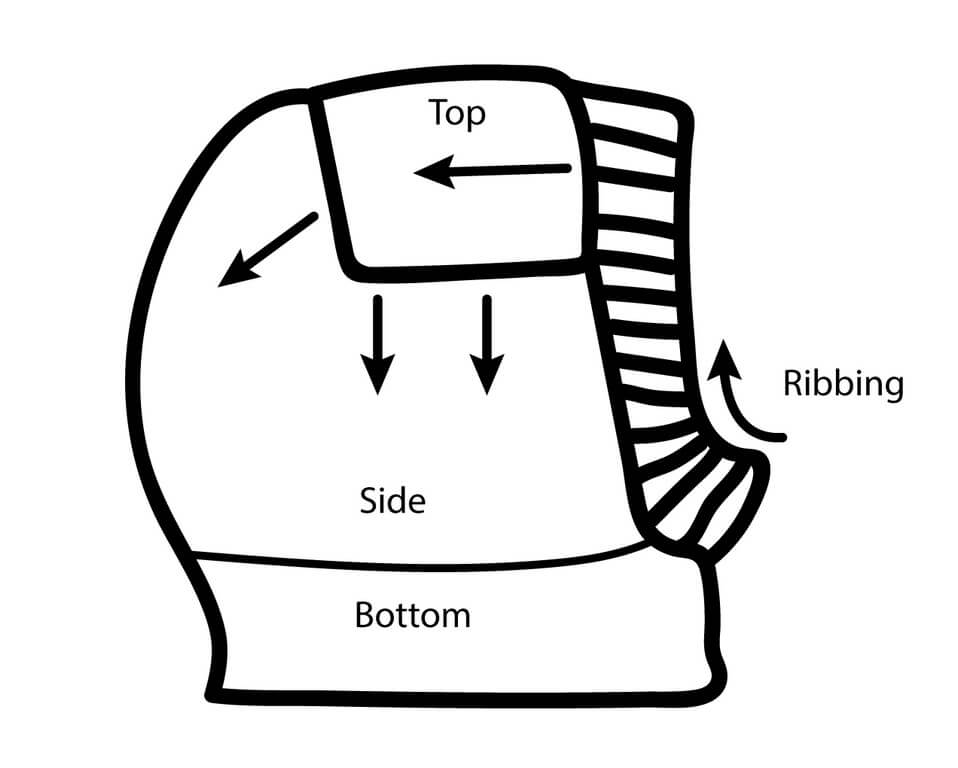
The schematic shows the construction (viewed sideways) and the arrows in it show the working direction for each section.
The top is made first, then the side, then the bottom part, then ribbing is added at the end.
Skill level
Confident beginner in Tunisian crochet, due to working different stitches and simple shaping.
Gauge
15 Tss and 14 rows for a 10 cm by 10 cm square (4″ by 4″).
Make a gauge swatch by following these instructions.
Row 1. Ch 25, pick up 25 loops in the back bumps of the chains, R –– 26 loops
Row 2. 24 Tss, Ls, R –– 26 loops
Repeat Row 2 another 24 times for a total of 26 rows.
Block the swatch by washing it and laying it flat to dry.
Measure a 10 by 10 cm (4″ by 4″) square in the middle of the swatch and count the stitches and rows.
Notions
Yarn: DK weight or size 3 wool or acrylic, with 300 meters per 100 grams; approximate usage: 330 meters or 110 grams.
Hook: 6 mm Tunisian crochet hook with cable, or long hook, or hook that gets you gauge (optional double ended hook).
Tapestry needle, scissors, tape measure.
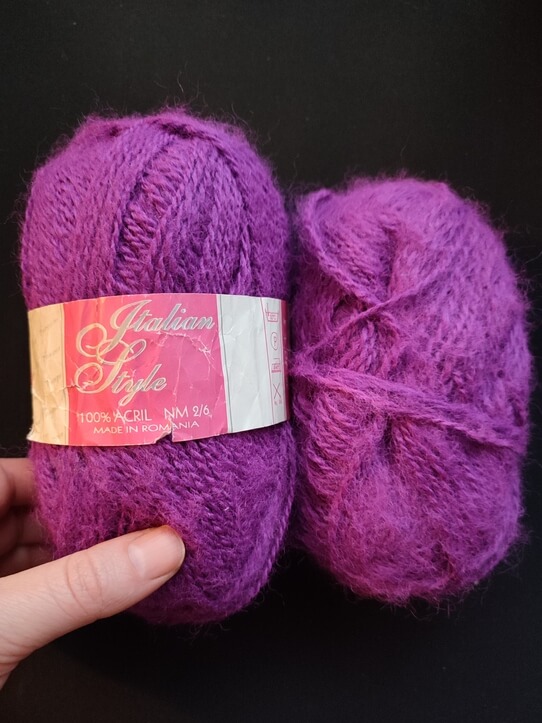
For the purple version, I used this really old acrylic yarn I had in my stash from my mom. This yarn is older than me and I never knew what to make out of it.
This balaclava was the right way to use it up. It’s a fuzzy two-ply yarn that is perfect for Tunisian crochet.
Observations
This balaclava is worked flat in one piece, then two short seams finish it.
If using a double ended hook, only one seam is necessary to finish the ribbing.
You can make the balaclava taller or shorter by varying the number of rows you make in the side (for the face) or at the bottom (for the neck).
You can make the balaclava wider or narrower by changing the width of the ribbing.
You can make the balaclava in a slightly different gauge to change the overall measurements.
Repeats are shown between *asterisk symbols*.
The loop count before the return pass (including the first loop) is noted in at the end of every row, after the — symbol.
Abbreviations
- Ch – chain;
- Fs – First stitch: loop on the hook left at the end of the return pass;
- Ls – Last stitch: insert the hook behind the two vertical bars at the end of the row, YO and pull up a loop;
- R – regular return pass: Ch 1, Rep *YO and pull through 2 loops on hook* until 1 loop remains;
- Rep – repeat;
- Sl St(s) – slip stitch(es);
- SM – stitch marker;
- SRR – short row return pass: Rep *YO and pull through 2 loops on hook* until 1 loop remains;
- St(s) – stitch(es);
- Tks – Tunisian knit stitch: insert the hook between the two vertical bars of the next St, YO and pull up a loop;
- Tps – Tunisian purl stitch: bring the yarn to the front, insert the hook under the vertical bar of the next St, YO and pull up a loop;
- Trpks – Tunisian reverse purl knit stitch: bring the yarn to the front of the hook, insert the hook from back to front between the 2 vertical bars of the next St, YO and pull up a loop;
- Tss – Tunisian simple stitch: insert the hook under the front vertical bar of the next St, YO and pull up a loop;
- Tss2Tog – Tunisian simple stitch 2 together (decrease): insert the hook under the front vertical bars of the next 2 Sts, YO and pull up a loop;
- Tssbf – Tunisian simple stitch back front (increase): insert the hook under the back vertical bar of the next St, YO and pull up a loop, insert the hook under the front vertical bar of the same St, YO and pull up a loop;
- YO – Yarn over.
Video tutorials
If you are not yet familiar with some of the stitches or techniques used in this pattern, use the video links below to get a refresher.
The first link is the right handed version, the second the left handed.
Foundation row in Tunisian crochet.
Tunisian simple stitch (Tss).
Tunisian simple stitch back front (Tssbf).
Casting on at the end of the forward pass.
Joining to work in the round.
Tunisian purl stitch (Tps).
Tunisian knit stitch (Tks).
Tunisian reverse purl knit stitch (Trpks).
Working into the side of a project (for ribbing).
Seaming honeycomb (minute 9:54).
Seaming Tks.
Weaving in ends.
Instructions
Top
Start with a slip knot on the hook, leaving a tail to weave in.
Foundation Row. Ch 31, pick up 31 loops in back bumps of chains, R — 32 loops
Rows 2-18. Tss across, Ls, R — 32 loops
Bind off with Sl Sts across the last row, including in the Ls. Do not cut the yarn.
Side
The row count resets.
Row 1. pick up 18 loops along the short side of Top, 30 Tss in Row 1 of Top, pick up 18 loops along the other short side of Top, pick up 1 loop in Fs of Row 18 of Top, R — 68 loops
Row 2. 18 Tss, Tssbf, 28 Tss, Tssbf, 18 Tss, Ls, R — 70 loops
Row 3. 19 Tss, Tssbf, 28 Tss, Tssbf, 19 Tss, Ls, R — 72 loops
Row 4. 20 Tss, Tssbf, 28 Tss, Tssbf, 20 Tss, Ls, R — 74 loops
Row 5. 21 Tss, Tssbf, 28 Tss, Tssbf, 21 Tss, Ls, R — 76 loops
Row 6. 22 Tss, Tssbf, 28 Tss, Tssbf, 22 Tss, Ls, R — 78 loops
Rows 7-18. Tss across, Ls, R — 78 loops
Row 19. 3 Tss, Tssbf, 18 Tss, Tss2Tog, 28 Tss, Tss2Tog, 18 Tss, Tssbf, 3 Tss, Ls, R — 78 loops
Row 20. Tss across, Ls, R — 78 loops
Rows 21-28. Repeat Rows 19-20 another 4 times. Do not cut the yarn.
Bottom
The row count resets. See the video tutorial on casting on at the end of the forward pass.
Row 1. Ch 4, pick up 4 loops in back bumps of chains, Tss across, Ls, CO 4 Sts, R — 86 loops
If you prefer, you can switch to working in the round with a double ended hook and add a second yarn for the return pass.
See the video tutorial for joining to work in the round.
Row 2. Rep *1 Tss, 1 Tps* across, Ls, R — 86 loops
If working in the round, replace the Ls with a Tss. For the next row, add a Tss before starting the repeat, replacing the Fs.
Row 3. Rep *1 Tps, 1 Tss* across, Ls, R — 86 loops
If working in the round, replace the Ls with a Tps. For the next row, add a Tps before starting the repeat, replacing the Fs.
Repeat Rows 2-3 another 4 times or until you are satisfied with the length of the Bottom. A longer piece can replace a scarf or cowl worn around the neck.
Cut off the yarn, leaving a tail, then seam the gap before adding the Ribbing (see instructions for First seam on the next page).
Ribbing
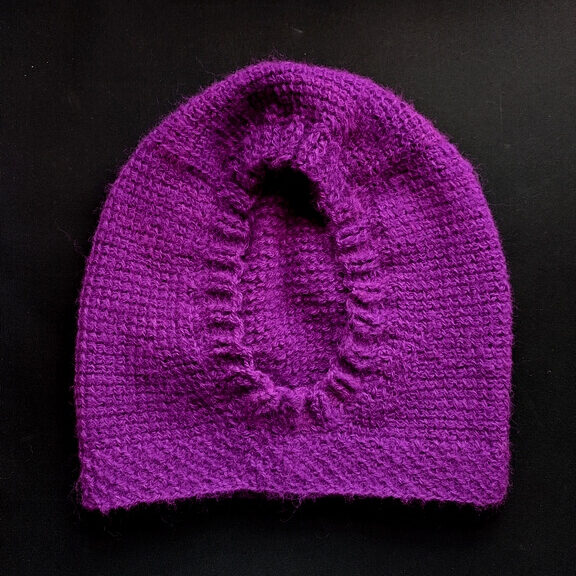
You can change the width of the balaclava by changing the width of the Ribbing. The ribbing stitch pattern is reversible.
When picking up loops in the Side, pick up the third loop on the back as well, where available (see the video tutorial for working into the side of a project).
You will work short rows in the ribbing pattern, anchoring each row into the beginning, side, or end of a row in the Top, Side, or Bottom.
Anchor the yarn in the lower left corner, between Bottom and Side.
Row 1. Ch 8, pick up 8 loops in back bumps of chains, pick up 1 loop in the same anchor point, SRR — 10 loops
Row 2. Tks across, pick up 1 loop in Ls of next Row from the Side, SRR — 10 loops
Row 3. Trpks across, pick up 1 loop in the next Row from the Side, SRR — 10 loops
Row 4. Trpks across, pick up 1 loop in the next Row from the Side, SRR — 10 loops
Row 5. Tks across, pick up 1 loop in in the next Row from the Side, SRR — 10 loops
Repeat Rows 2-5 around, ending with a repeat of Rows 2-4.
You will first finish one edge of the Side section, then work into the bound off stitches of the Top, then along the other edge of the Side section, then along the stitches cast on for the Bottom.
Make one row in the corner between Side and Bottom, to ensure a multiple of 4 rows.
Leave a long tail for seaming (2 times the length of the seam).
Seaming
You will use the tail to seam the last row of the Bottom to the first row of the Bottom, then the Ribbing to the first row of the Ribbing. If you used a double ended hook for the Bottom, your only seam is for the Ribbing.
The two different fabrics require a slightly different technique, which is illustrated in the two video tutorials mentioned.
First seam
For a visual representation, watch the video tutorial for “Seaming honeycomb”.
Make an invisible join at the bottom where the two sides of the Bottom section meet, using the tail.
Then insert the needle upwards through the return pass chain on one side, repeating the action through the last return pass chain on the same row.
Move up to the next row and repeat this action. Pull on the yarn to tighten the seam as you go. Weave in the end when you are finished seaming.
Second seam
For a visual representation, watch the video tutorial for “Seaming Tks”.
Rotate the project so the seam is vertical and the first row is at the bottom, the last row at the top.
Make an invisible join on the edge, between the last and first rows,
Insert the needle under both loops of the first Tks at the top.
Return to the bottom and insert the needle between the 2 vertical bars of the first stitch and come back up between the 2 vertical bars of the second stitch.
Go with the needle under the second Tks at the top.
Return to the bottom and insert the needle between the 2 vertical bars of the second stitch and come back up between the 2 vertical bars of the next stitch. Return to the top.
Go with the needle under the next Tks on the top. Return to the bottom.
Continue working in this manner until you run out of stitches in the Ribbing.
Pull on the tail regularly to close the gap. The starting chain should move to the back of the fabric.
Weave in the ends on the inside.
The balaclava should be ready for wearing after a gentle wash.
There is no need to steam block it if using acrylic or an acrylic mix, just lay it flat to dry.
The honeycomb and the ribbing will prevent curling.
Other patterns you might like
If you enjoyed this pattern, here are some more Tunisian crochet patterns for the cold weather that you might enjoy:
- Cowl and headband set
- Beanie pattern in 9 sizes for chunky yarn
- Elf or Santa hat
- Fingerless mittens with lace
- Houndstooth fingerless mittens with video tutorial
- Beanie pattern with elastic brim and rounded crown